A Spider Experiences The Dark Side of the Moon
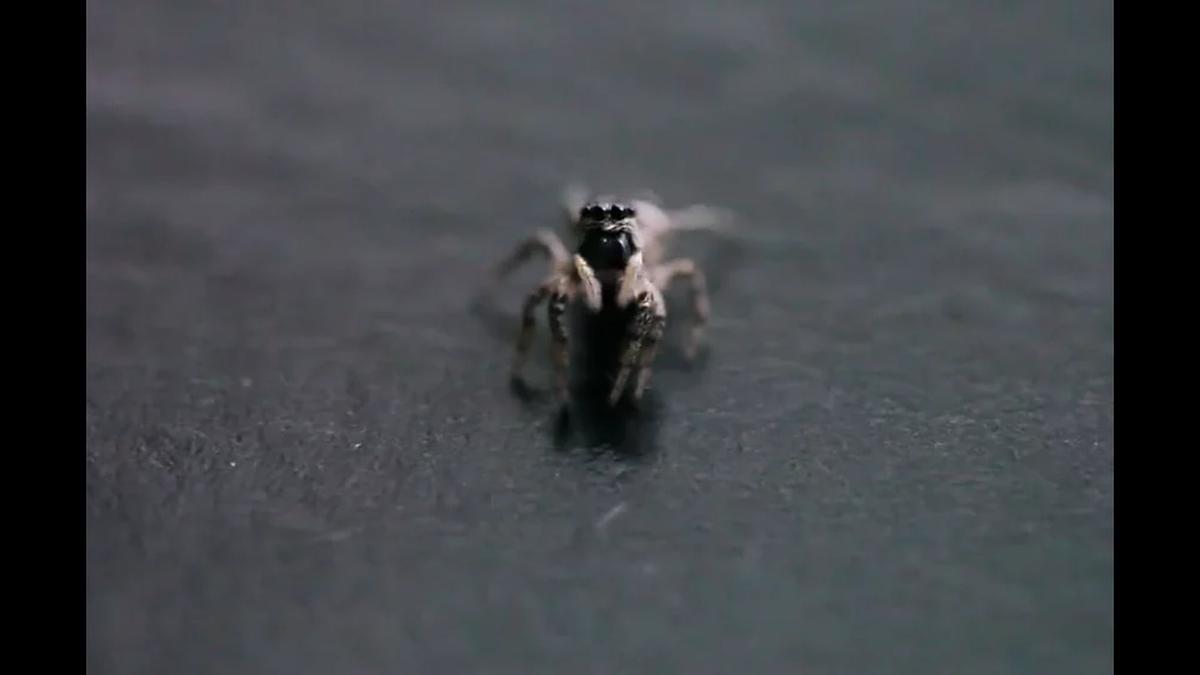
A Spider Experiences the Dark Side of the Moon, 2017
How does a being possessed of a radically different sensory reality experience something intimately familiar to many humans? A Spider Experiences the Dark Side of the Moon invites viewers to imagine the intense otherness of inhabiting the sensing body of a spider, as it physically and sonically explores Pink Floyd’s The Dark Side of the Moon.
Recent research shows that jumping spiders, like the zebra spider (Salticus scenicus) in this film, can hear across significant distances—something previously unknown to science. But unlike human beings, spiders hear by way of hundreds of fine hairs, called trichobothria, scattered across their articulated bodies—each one a single fully independent ear. Brian Kirkbride’s score for the short film builds on excerpts from five tracks from Dark Side, each undergoing a discrete attempt to acoustically manipulate and reshape the original as if heard through these hundreds of shimmering, vibrating spider “ears”.
Spiders, subject of many human nightmares, do not exist to frighten us. They live their own lives and experience their own umwelt, or circle of conscious concern. How can out own perceptions be expanded by imagining ourselves as this tiny voyager, experiencing an iconic human artifact as if it were in fact the vast surface of a remote moon?
Members of Pink Floyd have said The Dark Side of the Moon deals with the themes of alterity, empathy and unity. This film arose itself from a chance encounter with alterity, a moment of interaction between two very different creatures. Intrigued by this beautifully patterned spider’s intricate movements, Jenny Kendler grabbed her camera to document the being she saw walking across her and Kirkbride’s record collection. But what about the other participant in this encounter? In truth, we’re unable to know what the experience was actually like for the spider. What is important to remember is that it did have an experience. We hope that this can serve as a reminder to help us build empathy across the gap between human and non-human—even with one so radically other.