Shroud for an Atheist
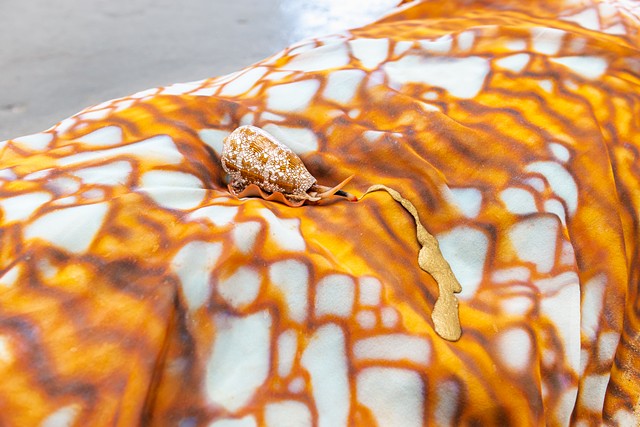
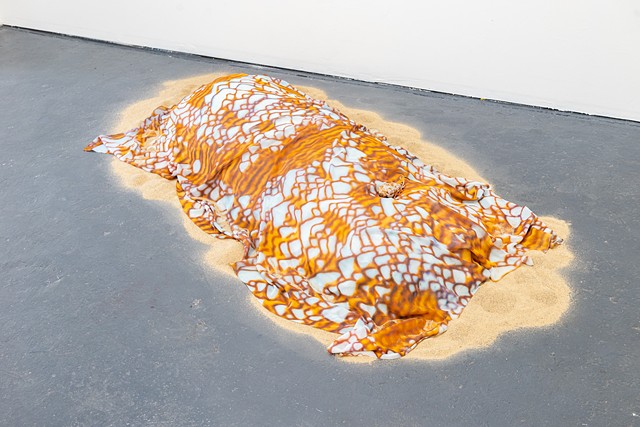
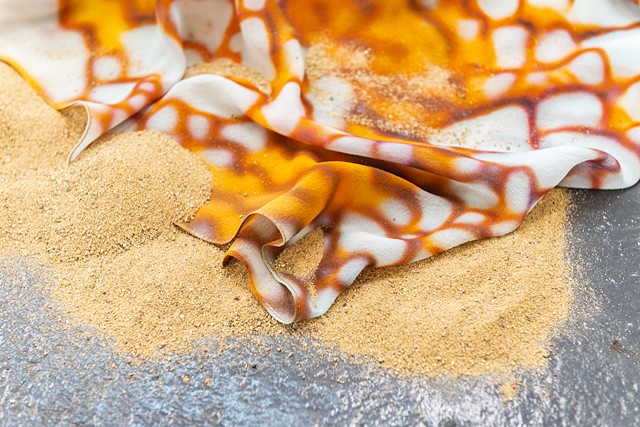
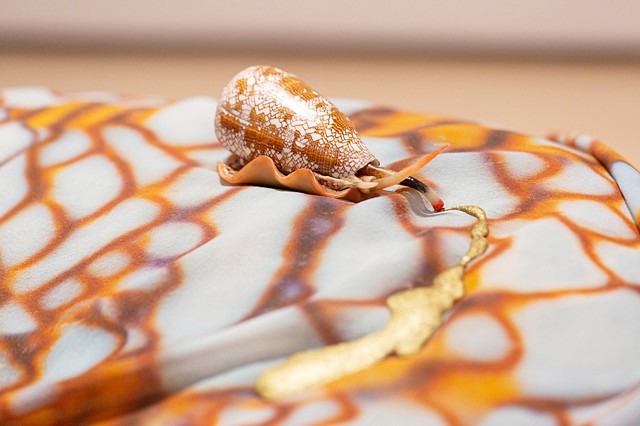



Shroud for an Atheist, 2020
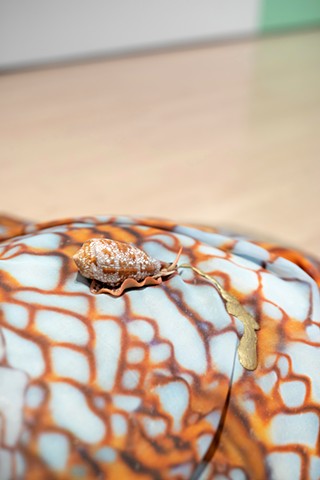
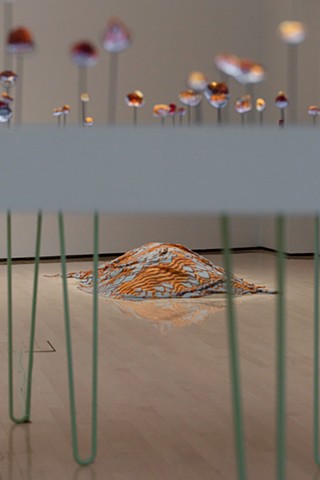
Digitally printed silk textile, seawater and interference-gold pigment, metallic acrylic, glass beads, sand, polymer clay,
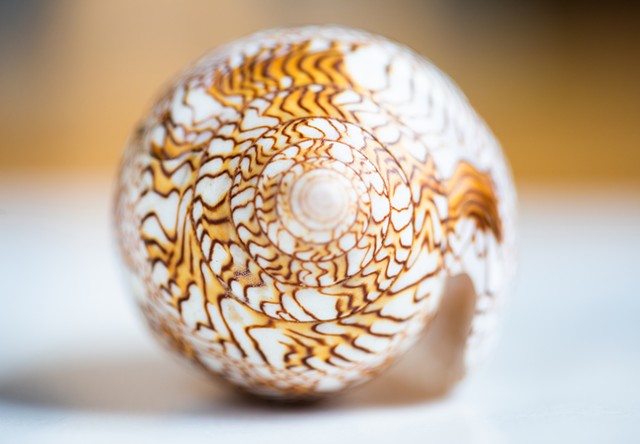
Textile Cone (Conus textile) shell
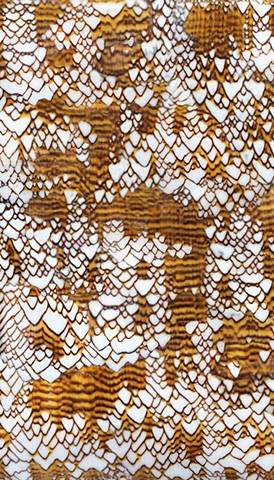
Conus textile is the Latin name of a species of marine snail whose beautifully patterned shell earns its common names: the Textile Cone. Yet beneath this allure lies a venomous mollusk whose toxins can be lethal to humans. Kendler meticulously tessellated images of the shell’s surface to generate this textile—a gesture that both echoes the creature’s name and mirrors the recursive logic by which the shell itself grows.
Presented atop a burial mound of sand, the work takes on the likeness of a shroud. But whose death are we to lament? The artist gives us a clue: the patterns of Conus textile recall cellular automata, as in Conway’s Game of Life or Wolfram’s Rule 30—computational models said to prove that complex design and intelligent organization can arise in the absence of a “designer.”
Presented atop a low burial mound of sand, the textile takes the form of a shroud. But whose death, the work asks, are we to mourn? The artist offers a clue: the Textile cone's repeating triangular pattern recalls cellular automata such as Conway’s Game of Life or Wolfram’s Rule 30—computational systems celebrated for demonstrating how intricate forms and seemingly intelligent organization emerge from simple rules, absent any central “designer.”
Thus, the work forms a subtle “strange loop” linking biology and culture in a recursive exchange—suggesting that meaning-making around mortality can emerge from more than theories of transcendence, but rather from the beautifully-interdependent structures of the living world itself.
Exhibited at:
Jenny Kendler: The Long Goodbye : MSU Broad Museum : Lansing, MI : Jan. 15 – Jun. 27, 2021